
Nikro Air Duct Cleaning in Huntington Beach: A Homeowner’s Guide
The most common complaint we hear about duct cleaning – that it stirred up dust and made allergies worse instead of better – almost always traces back to one thing: not enough containment pressure. A vacuum that can’t keep up with the debris it’s loosening just moves that debris around. Nikro systems were engineered to solve exactly that problem, and understanding how they work is the surest way to tell a real cleaning from a cosmetic one.
Key Takeaways
- Nikro systems pair high-CFM negative pressure with HEPA-grade filtration to hold debris instead of releasing it back into your rooms.
- “Negative-pressure vacuum” on a quote doesn’t mean much by itself. Filter rating and sustained airflow are what separate one machine from another.
- A proper Nikro cleaning is verifiable in real time: camera inspection, controlled brush agitation, sealed registers, and visible before-and-after photos.
- Cleaning alone doesn’t fix leaky ducts. Repair and sealing are what protect the gains after the debris is gone.
Why contain the dust in the first place?
Because every particle you break loose in a duct has to go somewhere. If it can’t be captured, it gets pushed into living spaces. That’s the whole logic behind Nikro industrial vacuums.
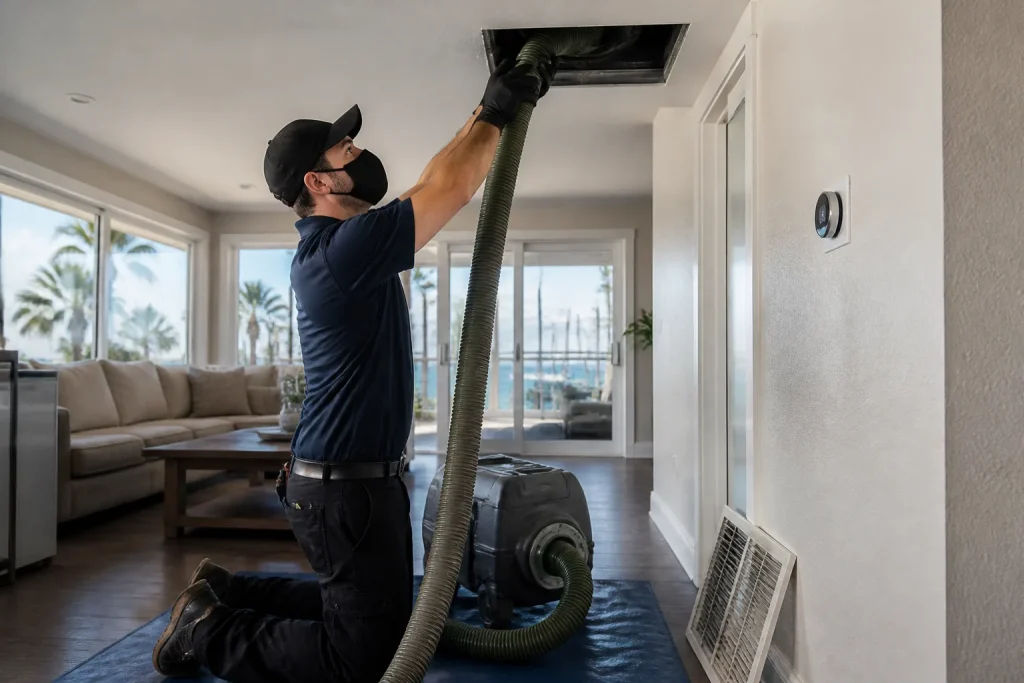
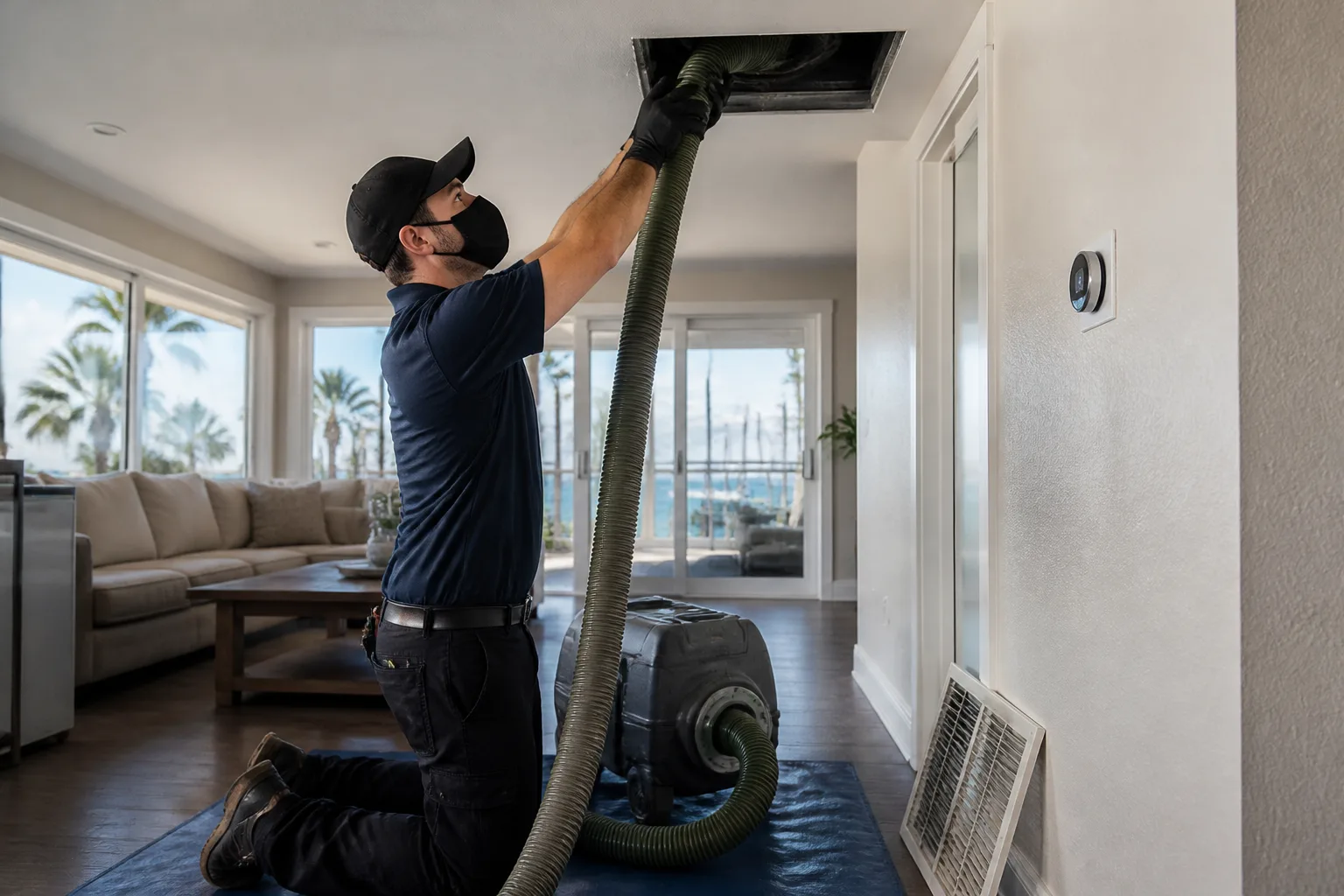
A Nikro setup isn’t a stronger shop vac. It’s a negative-pressure machine: it pulls a steady vacuum on the duct system so the entire network sits under suction while a rotating brush disturbs what’s stuck to the walls. Loose debris travels toward the vacuum, not out through the nearest supply register. The unit’s HEPA-stage filtration traps fine particulate inside the canister, and the bag-and-filter stack keeps it there until it’s removed. The concept is the same one commercial facilities use when they clean large HVAC systems during occupied hours – you can’t afford to spread contaminants, so you contain them.
Nikro cleaners are built for sustained airflow against real static pressure. A short, weak pull collapses the moment a brush meets a clogged return. A unit designed for the work holds its draft. In our experience, that difference is where most “it made things worse” stories begin and end. If the machine can’t sustain pressure, the brush isn’t really cleaning; it’s just rearranging the problem.
How does a Nikro cleaning actually work, step by step?
It works in a sequence, and knowing that sequence lets you watch and confirm the job is being done right. Here’s what should happen.
- 1
Inspection first. A technician runs a camera through the main trunk and branch lines to see the real condition: dust load, debris type, moisture, and any obvious damage or disconnection. No cleaning starts before that look.
- 2
Connect and pressurize. The Nikro unit is tied into the system at a main access point, and the network is brought under negative pressure before anything is disturbed.
- 3
Seal the working space. Registers and openings are covered or blocked so dislodged material stays inside the system. This is the containment step people skip and later regret.
- 4
Agitate, don’t just suck. Contact cleaning – the rotating brush, air whips, and controlled movement through each branch – is what lifts debris stuck to duct walls. Suction alone leaves a film behind.
- 5
Re-inspect and show you. A second camera pass confirms the result. Before-and-after photos of your own ducts are the honest proof a homeowner should expect.
- 6
Clean up and reset. Filters, registers, and grilles get handled and everything goes back together.
If a company shows up with only a portable unit and doesn’t offer a camera pass or sealed registers, the cleaning may be real but the containment likely isn’t. That’s a question worth asking before anyone starts.
Do all negative-pressure vacuums do the same job?
No, and the difference matters. “Negative-pressure vacuum” describes a method, not a standard. Two machines can both use the method and deliver very different results, because what leaves the system depends on filter rating and sustained airflow, not on the label.
- Filter rating. A true HEPA filter catches the fine particulate that ordinary filters pass. If the filtration stage is a coarse bag or a basic filter, fine dust can blow back through. Ask what filter class the unit uses.
- Sustained CFM under load. CFM on a spec sheet means little once the machine is fighting real static pressure. What you want is strong airflow that holds up while the brush is working a long run of duct.
- Contaminant capture. Equipment built for remediation work – the kind associated with Abatement Technologies air-quality gear – is designed to hold what it collects. That’s the standard serious duct cleaning should be measured against.
- Brush contact. A contact method like the Rotobrush system physically scrubs duct walls. A blower with no brush contact only loosens loose debris; it doesn’t clean what’s stuck.
So when a quote says “we use negative pressure,” that’s a starting point, not an answer. Filter grade, real airflow, and brush contact are what tell you whether the job is thorough.
Why does Huntington Beach duct cleaning demand stronger suction?
Huntington Beach homes have a specific dust character that punishes weak equipment. Warm, dry stretches through the year load the air with fine sand and windblown grit, and homes that keep windows open collect it deep in the return lines. That material is heavier and finer than ordinary house dust, and it settles where a light vacuum can’t reach it.
Fine sand and grit behave differently from fluffy dust. They compact against duct walls and cling in the low points of the trunk lines, and they don’t lift off with a weak pull. You need real suction and brush contact to break that layer loose and capture it. When the machine is underpowered, the loose grit goes airborne into the rooms – which is why some homeowners in Huntington Beach describe a cleaning that left everything feeling dustier afterward.
Add to that the renovation-dust problem. Any home that’s had drywall, flooring, or a kitchen remodel done pulls fine construction particulate through the return side. It’s the kind of material that needs containment, not a shop vac. This is the practical reason we lean on professional-grade systems here rather than a portable blower: it’s a fit to the actual dust load, not a sales flourish.
When is cleaning alone not enough?
Cleaning removes what’s in the ducts. It doesn’t close the gaps that let new dust, allergens, and outdoor air in. When we inspect a Huntington Beach system, the question we’re really answering is: is this a cleaning job, or a cleaning-plus-repair job?
Signs that sealing and repair need to follow the cleaning:
- Loose joints, disconnected sections, or visible gaps at the trunk or at registers.
- Energy bills that climb even when the system runs normally – leaking ducts pull conditioned air into walls and attics.
- Musty or stale odors that return soon after a cleaning, which often points to moisture or a leak feeding the problem.
- Dust settling fast on surfaces after the ducts were just cleaned.
This is where the full-resolution approach pays off. Duct repair and sealing in the same visit means the system is cleaned and then closed up, so the improvement holds. Post-clean sanitizing and Guardsman protective treatments address surfaces inside the system, and knowing your Honeywell or Aprilaire filtration and purification equipment lets a technician tune it to the cleaned system rather than leaving it out of sync. Clean it, seal it, sanitize it – not just the first step.
When to call a pro
Call a professional when you’re seeing the signs that a shop vac can’t fix: persistent allergy symptoms that don’t improve, musty smells when the system kicks on, visible dust blowing from registers, recent renovation dust, or a duct system you’ve never had inspected. Those are jobs where containment and equipment quality actually determine the outcome. Our technicians have up to 9 years of experience running professional-grade equipment on residential and commercial systems, and the local pro we connect you with is licensed and insured as their state requires.
Also call a pro for the part most HVAC-only cleaners skip entirely: your dryer vent. A clogged dryer vent is a fire hazard, and it’s one of the leading causes of residential fires. Routine dryer vent cleaning is safety work, not a luxury. It’s part of the same visit when we’re already there.
Our air duct cleaning and HVAC cleaning services cover the whole system, so you’re not coordinating multiple contractors. For a broader look at what we do, our Huntington Beach Air Duct Cleaning Pros page lays it out.
Related services in Huntington Beach
Cleaning, dryer vent service, HVAC cleaning, duct repair and sealing, and sanitizing – all handled in one engagement so nothing falls between contractors.
The Bottom Line
The Nikro difference comes down to one mechanical idea: keep the debris under control and remove it, don’t redistribute it. Strong sustained suction, HEPA-grade filtration, brush contact, and sealed registers are what separate a real cleaning from a costly stir-up. In Huntington Beach, where fine sand and grit get into the returns all year, that containment standard is what your ducts actually need. Pricing is one flat price per system, agreed before work starts from a free written estimate, so you know the number up front. Before-and-after photos of your own ducts are the proof to ask for.
If you’re in Huntington Beach and need help, Huntington Beach Air Duct Cleaning Pros offers free estimates – call (866) 937-7145. We answer 24/7. Fast dispatch from 7am to 7pm, Sunday through Friday.
Frequently Asked Questions
Usually, yes – because the difference isn’t just price, it’s containment. A cheap service often relies on a portable unit without HEPA-grade filtration or sealed registers, which can leave fine dust in your air. A Nikro cleaning is built to capture what it loosens. Call (866) 937-7145 for an exact quote – estimates are free.
The timing depends on system size, duct layout, and how much debris has built up, so a proper job is scheduled around your system rather than rushed to fit a coupon window. Ask for a written estimate that names what’s included. Call (866) 937-7145 and we’ll walk you through it.
Ask for a camera inspection before and after, and before-and-after photos of your own ducts. A technician using a Nikro system should also seal registers and run a second camera pass to confirm the result. If a company can’t show you that, you can’t confirm the cleaning happened. Call (866) 937-7145 to book a free estimate.
Every few years is a sensible rhythm for most homes, and sooner after a renovation, a move-in, or if anyone in the household has allergy symptoms or you notice musty odors. Homes with heavy dust loads may want it checked more often. Call (866) 937-7145 – estimates are free and the flat price per system is set in writing before work starts.
Written by the team at Huntington Beach Air Duct Cleaning Pros.
Need Air Duct Cleaning Help?
Call Huntington Beach Air Duct Cleaning Pros - the local pro we connect you with is licensed and insured, with free written estimates in Huntington Beach.
(866) 937-7145